
Integrated Human
and Environmental
Risk Assessment
Risk assessment enables the characterization of potential hazards associated with chemical exposures, helping to determine exposure levels that are unlikely to pose significant risks to human health. Physiologically Based Kinetic (PBK) models play a critical role in this process by simulating toxicokinetics, the movement of chemicals through the body. These models quantitatively describe the absorption, distribution, metabolism, and excretion (ADME) of substances by integrating compound-specific and organism-specific data. PBK models allow for refinements in risk assessment with their application in cross-species, route-to-route and high-dose to low-dose extrapolations.
While PBK models have traditionally been applied in human health risk assessments, they are increasingly used in environmental risk assessment to support interspecies extrapolation and ecological modeling. Our team actively contributes to expanding their application to both experimental animals and ecological model organisms.
Traditional risk assessment relies primarily on animal bioassays. In the context of Next Generation Risk Assessment (NGRA), where there is a growing imperative to reduce, refine and ultimately replace animal testing, PBK models serve as a cornerstone. Here, they enable the translation of in vitro toxicity findings into meaningful exposure metrics, thereby providing a scientifically robust bridge between in vitro effect concentrations data and real-world exposure levels. This allows for the derivation of alternative Points of Departure (PoDs) and supports a shift toward more ethical, efficient, and mechanistically informed risk assessment frameworks that align with modern principles of human relevance and animal welfare.
Physiologically based biopharmaceutics modeling (PBBM) is a specific field of PBPK model applications that aims to establish the link between the formulation’s properties and in vivo performance.
This field of application of PBPK modeling is evolving at a fast-pace and offers the link between in vivo and in vitro to support pharmaceutical development in the selection of the best drug substance and product, as well as later in development in the establishment of manufacturing quality and controls.
Dissolution testing is often a key input in PBBM. Results from in vitro experiments characterizing drug substances and the formulation behavior (e.g., solubility, particle size, dissolution) can be linked to key ADME parameters and integrated into full PBPK models to predict PK exposure in plasma and/or specific tissues or organs.
These models can also be linked to Pharmacodynamic (PD) relationships to derive the impact of physicochemical, drug and formulation properties on safety and efficacy. The role of Physiologically Based Biopharmaceutics Modeling (PBBM) in drug development spans multiple stages, including supporting patient-centric design, guiding life cycle management, informing regulatory submissions, streamlining development processes, optimizing dosing strategies, enhancing study design, and aiding in formulation development and developability assessment.

What we can offer
ESQlabs provides expert PBK model design for quantitative predictions of internal exposure or reverse dosimetry. The models can be based on human physiology or other model species and can be tailor-made for sensitive populations (e.g. pregnant women). Our focus extends beyond the development of the PBK models into developing methodologies for using in vitro/in silico data as model input parameters and for deriving in vitro-based PoDs. Thus, through our efforts we help drive NGRA forward, contributing to the reduction of animal testing while delivering more predictive and human-relevant chemical safety assessment.
When sufficient data are available, PBK applications can support environmental risk assessment in the framework of NGRA. Our models are tailored to predict internal-to-external exposure levels across species relevant in environmental risk assessment, including model species and wildlife species.
Our PBK services use the OSP Suite, PK-Sim and MOBI but can also include the integration of PBK models in other open-source platforms (e.g. TK plate, US EPA httk). Our IVIVE and QIVIVE workflows often include R scripts for a seamless integration of models and other statistical analyses.
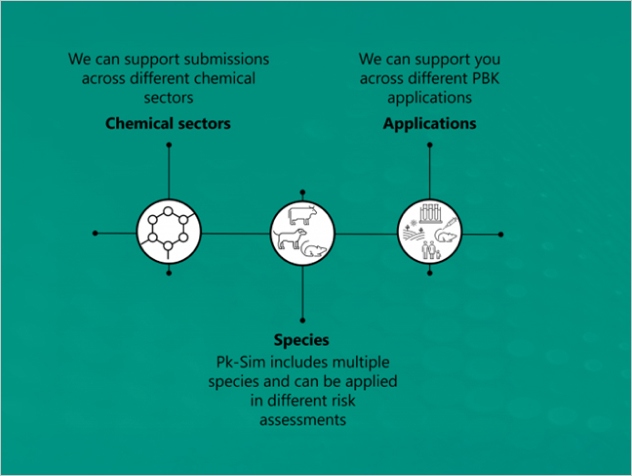
We provide services across diverse chemical sectors, with OSP suite offering multi-species support for a wide range of risk assessments. Our expertise extends to various PBK applications, ensuring tailored solutions for your specific needs.
Related Platforms

High-Throughput Screening and ADMET-PBPK

Large Molecules, Biologics and Novel Modalities
Small Molecules and Chemicals
QSP Disease and QST Models
Related publications and initatives
Meet the Team

Hsing-Chieh Lin (Candice)
Hsing-Chieh (Candice) earned her Ph.D. in Toxicology from Texas A&M University, where her research integrated in vitro assays with computational modeling to enhance toxicokinetic and hazard predictions. She also holds an M.S. in Bioenvironmental Systems Engineering from National Taiwan University and a B.S. in Biomedical Science and Environmental Biology from Kaohsiung Medical University.
She is currently a Scientist at ESQlabs GmbH, where she develops and applies physiologically based pharmacokinetic (PBPK) and in vitro-to-in vivo extrapolation (IVIVE) models to support next-generation risk assessment (NGRA) for chemicals. She is dedicated to bridging experimental and computational methods to make chemical safety evaluation more reliable and efficient.

Lara Lamon
Lara Lamon is an Environmental Scientist with a solid drive to investigate the unknowns of chemical exposure and enhance model simulations aimed at protecting human health and the environment.
She worked at ECVAM within the JRC on the grouping and read-across of nanomaterials. Lara contribiuted to applying the read-across framework released by ECHA to support nanomaterials dossiers submissions under the REACH regulation. She further advanced this expertise in the H2020 GRACIOUS project. Additionally, she has developed and applied modeling approaches to estimate environmental emissions and concentrations of environmental and emerging pollutants, including uncertainty analysis (Monte Carlo and sensitivity analysis).
Lara obtained her Ph.D. in Environmental Science at the Ca’ Foscari University of Venice at the Environmental Chemistry and Risk Assessment Unit. During her Ph.D., she was a visiting scholar at the Safety and Environmental Technology group at ETH Zürich, where she collaborated with Martin Scheringer and Matthew Macleod at the Safety and Technology group.

Marco Siccardi
Marco is a Clinical Biologist by training with a PhD in molecular pharmacology and PK/PD modelling. He spent over 15 years at the University of Liverpool working on the topic of pharmacogenetics and in developing PBPK approaches for the optimisation of drug delivery, including HIV therapy optimisation.
Marco has most recently been working with CROs in taking this approaches for modelling and simulation approaches and PKTK (Systems Toxicology) models across a number of disease areas.
Marco leads the Systems Toxicology team with the aim to promote collaborative innovation and to develop novel modeling approaches to streamline the toxicological assessment.
- Development of an end-to-end Quantitative Model-Informed Drug Development (MIDD) ECOSYSTEM
- A review of OSP suite PBBM capabilities: looking ahead
- Roadmap for action for advancing aggregate exposure to chemicals in the EU
- Application of High-Throughput PBPK Modeling to Develop an IVIVE Approach for Oral Permeability
- Enhancing PB(P)K Models for the Female Reproductive Tract: A Framework for Local and Systemic Drug Kinetics
- Advancing Maternal-Fetal and Lactation PBK Models for Cross-Species Risk Assessment in Toxicology
- High-Throughput PBPK Framework in R using Open Systems Pharmacology Software for Anti-Tuberculosis Drug Development

Marjory Moreau
A leading expert in human systems biology and chemical safety assessment, Marjory brings world-class expertise in physiologically-based pharmacokinetic (PBK) modeling and quantitative in vitro to in vivo extrapolation (QIVIVE). With a PhD in Toxicology from the University of Montreal and a postdoctoral fellowship at Health Canada’s Computational Toxicology Laboratory, she has dedicated her career to advancing 𝐍𝐞𝐱𝐭-𝐆𝐞𝐧𝐞𝐫𝐚𝐭𝐢𝐨𝐧 𝐑𝐢𝐬𝐤 𝐀𝐬𝐬𝐞𝐬𝐬𝐦𝐞𝐧𝐭 (𝐍𝐆𝐑𝐀) and bridging cutting-edge science with 𝐫𝐞𝐠𝐮𝐥𝐚𝐭𝐨𝐫𝐲 𝐝𝐞𝐜𝐢𝐬𝐢𝐨𝐧-𝐦𝐚𝐤𝐢𝐧𝐠. At ESQlabs, she will lead NGRA initiatives in the U.S., positioning us as a trusted regulatory partner while strengthening support for our American clients.

Stella Fragki
Styliani (Stella) Fragki is a Senior Scientist in Systems Toxicology at ESQlabs, where she applies physiologically based kinetic (PBK) modeling in chemical risk assessment. Her work focuses on integrating New Approach Methodologies (NAMs) within the framework of Next-Generation Risk Assessment (NGRA), with the aim of supporting human-relevant and animal-free safety evaluations.
She is a certified European Registered Toxicologist and has been active in the field of toxicological risk assessment since 2010, supporting the (agro)chemical industry with dossier preparation for plant protection products, biocides, and REACH-regulated substances.
Stella holds a degree in Biology from Thessaloniki, Greece, and an MSc in Food Safety from Wageningen University in the Netherlands. Her PhD research focused on quantitative in vitro to in vivo extrapolation (QIVIVE) using physiologically based kinetic (PBK) modeling, integrating data from both in vitro and in silico sources. Stella is also a certified European Registered Toxicologist.
- Towards best use and regulatory acceptance of generic physiologically based kinetic (PBK) models for in vitro-to-in vivo extrapolation (IVIVE) in chemical risk assessment
- Towards best use and regulatory acceptance of generic physiologicallybased kinetic (PBK) models for in vitro‑to‑in vivo extrapolation (IVIVE)in chemical risk assessment
- Advancing PFAS risk assessment Integrative approaches using agent-basedmodelling and physiologically-based kinetic for environmental andhealth safety
- EFSA Project on the use of NAMs to explore the immunotoxicity of PFAS
- Advancing Maternal-Fetal and Lactation PBK Models for Cross-Species Risk Assessment in Toxicology

Susana Proença
Susana Proença is a biologist and toxicologist dedicated to the leveraging in vitro and in silico data for parameterizing PBPK models and to perform chemical safety assessment. She is focused on developing frameworks and case-studies for IVIVE, extrapolation of ADME properties from in vitro to in vivo, and on QIVIVE, extrapolating in vitro effect concentrations to in vivo doses. She has experience in working with PBPK models both in OSP and in R.
Before joining ESQlabs, she worked at Wageningen University, Toxicology division under Dr. Nynke Kramer supervision. There she worked on evaluating in vitro kinetics of chemical related to different toxicological ontologies (such as cholestasis and development neurotoxicity) and developing strategies for performing QIVIVE for these chemicals. Before this she underwent an internship at ECVAM-JRC on in silico modelling of in vitro kinetics, which was followed by a stint automating chemical data curation from REACH dossiers, also in JRC.
Susana obtained her Master’s degree in Bio-Pharmaceutical Sciences from Faculty of Pharmaceutical Sciences, Lisbon University (Portugal). For her PhD thesis, she studied the in vitro kinetics in complex in vitro models and (Q)IVIVE of highly lipophilic chemicals. The thesis was supervised by Dr. Nynke Kramer at the Institute for Risk Assessment Sciences at Utrecht University. The work was multidisciplinary, envolving setting in vitro experiments, analytical methods, transcriptomics analysis and in silico modelling. Her PhD thesis will be submitted soon.
- Workshop Report no.40 – Chronos and Kairos: Understanding time in biology for NGRA
- Application of High-Throughput PBPK Modeling to Develop an IVIVE Approach for Oral Permeability
- Effective exposure of chemicals in in vitro cell systems: A review of chemical distribution models
- Harnessing Open-Source Solutions: Insights From the FirstOpen Systems Pharmacology (OSP) Community Conference
- Harnessing Open-Source Solutions: Insights From the First Open Systems Pharmacology (OSP) Community Conference

